How to Take Omega-3: Daily Dose, Timing, Meals and Duration
The largest number on a fish-oil bottle rarely answers how much EPA and DHA you will take. Use this practical guide to interpret the label, organise a routine and understand when individual advice matters.
Quick Answer
Calculate omega-3 intake from the EPA plus DHA amounts and the serving size, then follow the exact product label or prescription. There is no universal capsule count for every adult. Meal instructions vary by formulation; choose a consistent permitted time. Clinical treatment doses and expected benefits require an individual plan.
Key Takeaways
- Total fish-oil weight, EPA+DHA content and capsule count are three different measurements.
- Nutrition guidance describes intake; it is not an automatic prescription to add that amount as a supplement.
- A clear purpose and review plan are more useful than increasing the dose whenever you notice no change.
Two people can both say “I take one fish-oil capsule” and be taking very different amounts of omega-3. One bottle may provide a modest EPA+DHA amount per capsule; another may be several times more concentrated.

Learning how to take omega-3 begins with that label difference. Once it is clear, questions about meals, morning versus night and how long to continue become easier to answer. This guide is for adults comparing products in Bangladesh; children and pregnancy need their own suitability checks.
Step 1: identify what the milligrams describe
Find three entries on the pack: total fish oil, EPA and DHA. Add EPA and DHA together, then check whether the amounts are for one capsule or a serving containing several capsules.
| Illustrative label | EPA per capsule | DHA per capsule | Combined EPA+DHA |
|---|---|---|---|
| Example A: 1,000 mg fish oil | 180 mg | 120 mg | 300 mg |
| Example B: 1,000 mg concentrated fish oil | 360 mg | 240 mg | 600 mg |
These are arithmetic examples, not descriptions of products currently offered or recommended doses. The front labels show the same total oil weight, while the combined EPA+DHA amount differs.
If a serving is two capsules and the panel lists amounts per serving, do not multiply that figure by two again. Write the calculation once: EPA+DHA per capsule × capsules taken daily. Keep milligrams and grams consistent; 1 gram equals 1,000 milligrams.
How much omega-3 do adults need?
Different guidance may refer to different fatty acids. The NIH Office of Dietary Supplements explains that US adequate-intake values for adults are established for ALA, the plant omega-3, rather than a universal EPA+DHA requirement. ALA figures should not be read as fish-oil capsule instructions.
EFSA's nutrition assessment describes an adult adequate intake of 250 mg a day of combined EPA+DHA. This is a population nutrition reference for total intake. It does not mean every adult must add a 250 mg supplement regardless of food, health conditions or other products.
Consider your existing diet first. If fish is a regular part of meals, ask whether there is a dietary gap to fill. If you avoid fish, discuss suitable alternatives, including a labelled algal source. A clinical recommendation for high triglycerides or another condition belongs in a separate treatment plan.
Why “four grams” is not four ordinary capsules
Some clinical regimens use gram quantities of a prescription omega-3 formulation. That number describes a particular treatment, not the total oil weight on any bottle with a fish picture.
Do not build a treatment dose by taking large numbers of ordinary capsules. You may miscalculate the active amount, duplicate other ingredients or bypass the safety review that accompanies prescribing. For elevated blood fats, see our triglyceride and cholesterol guide and take your report to the clinician.
What is the best time to take fish oil?
There is no universal best clock time. Follow the meal and frequency directions for the exact formulation, then select a time you can remember consistently. A routine that fits breakfast or dinner is usually easier to maintain than chasing an unsupported “perfect hour.”
MedlinePlus medicine instructions show that food requirements differ between prescription formulations. Its general advice is to follow the prescription or package directions and use a consistent schedule.
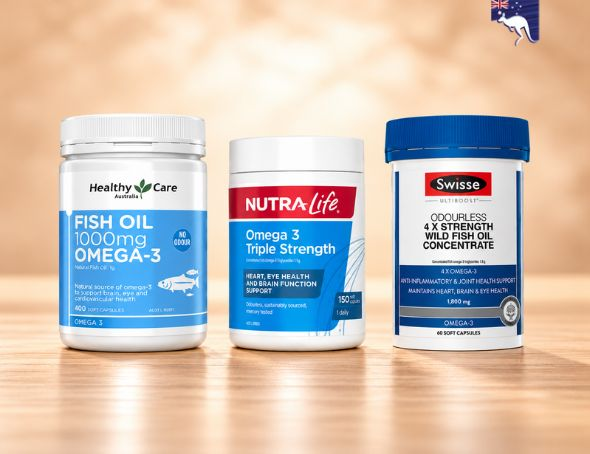
For a manufacturer example, Swisse's Odourless High Strength Wild Fish Oil directions specify taking it during or immediately after a meal. That instruction belongs to that product; check your own pack rather than applying it to every medicine or supplement.
During Ramadan, a shift change or travel, ask a pharmacist how to fit the existing directions around the new meal schedule. Do not compress several prescribed doses into one simply because the usual timing is inconvenient.
Can you take omega-3 on an empty stomach?
Use the label's answer. When it specifies food, take it with the meal as directed. When directions are unclear, ask the pharmacist before inventing a routine. There is no need to add a very fatty meal just to accompany a capsule.
If burping, reflux or nausea begins, record when it occurs and whether it follows the supplement. Check that you have not accidentally increased the serving. Persistent symptoms deserve advice; changing the clock time repeatedly should not delay a review.
Should you divide the daily amount?
Some products or prescriptions specify divided doses; others allow a single daily serving. Follow that distinction. A large daily number printed for one purpose should not be copied into a different purpose or product.
If swallowing is difficult, discuss a suitable formulation. Do not cut or open a capsule unless that exact product's directions permit it. A liquid requires its own measurement and storage instructions; teaspoons from the kitchen are not a reliable substitute for a supplied measuring device.
How long does omega-3 take to work?
The answer depends on what “work” means. Increasing intake is different from improving a laboratory result, and both differ from noticing a symptom change. Many hoped-for benefits are not established, so there may be no symptom improvement to time.
| Your purpose | How to judge progress |
|---|---|
| Filling a dietary gap | Check whether the food and supplement routine meets the agreed nutritional purpose. |
| Prescribed lipid treatment | Use the clinician's follow-up blood test and review schedule. |
| A symptom such as stiffness or poor concentration | Establish the cause, evidence and review point before using a supplement trial. |
Do not treat a seven-day marketing promise as a clinical timetable. Record the start date and relevant changes, then review the plan rather than automatically buying a stronger bottle. If symptoms worsen, seek advice sooner.
What if you miss a dose?
Check the medicine leaflet or product instructions. MedlinePlus advises against doubling a prescription omega-3 dose to make up for a missed one. Ask a pharmacist if you are uncertain about the next dose or cannot remember whether you took it.
A simple tick on a calendar can prevent repeated uncertainty. When someone helps an older relative with medicines, agree who records each dose so two people do not unknowingly give the same supplement.
Who needs a safety review first?
Discuss the exact product before starting if you take anticoagulants or antiplatelet medicines, have a bleeding problem, seafood allergy or a heart-rhythm disorder, or have a planned procedure. The NCCIH safety overview explains why medicine interactions and individual circumstances matter.
Pregnancy, breastfeeding and use in children also need age- and life-stage-appropriate advice. Ordinary fish oil, cod liver oil and a prenatal combination are different formulations. Check the entire ingredient list, particularly when another supplement already supplies vitamins.

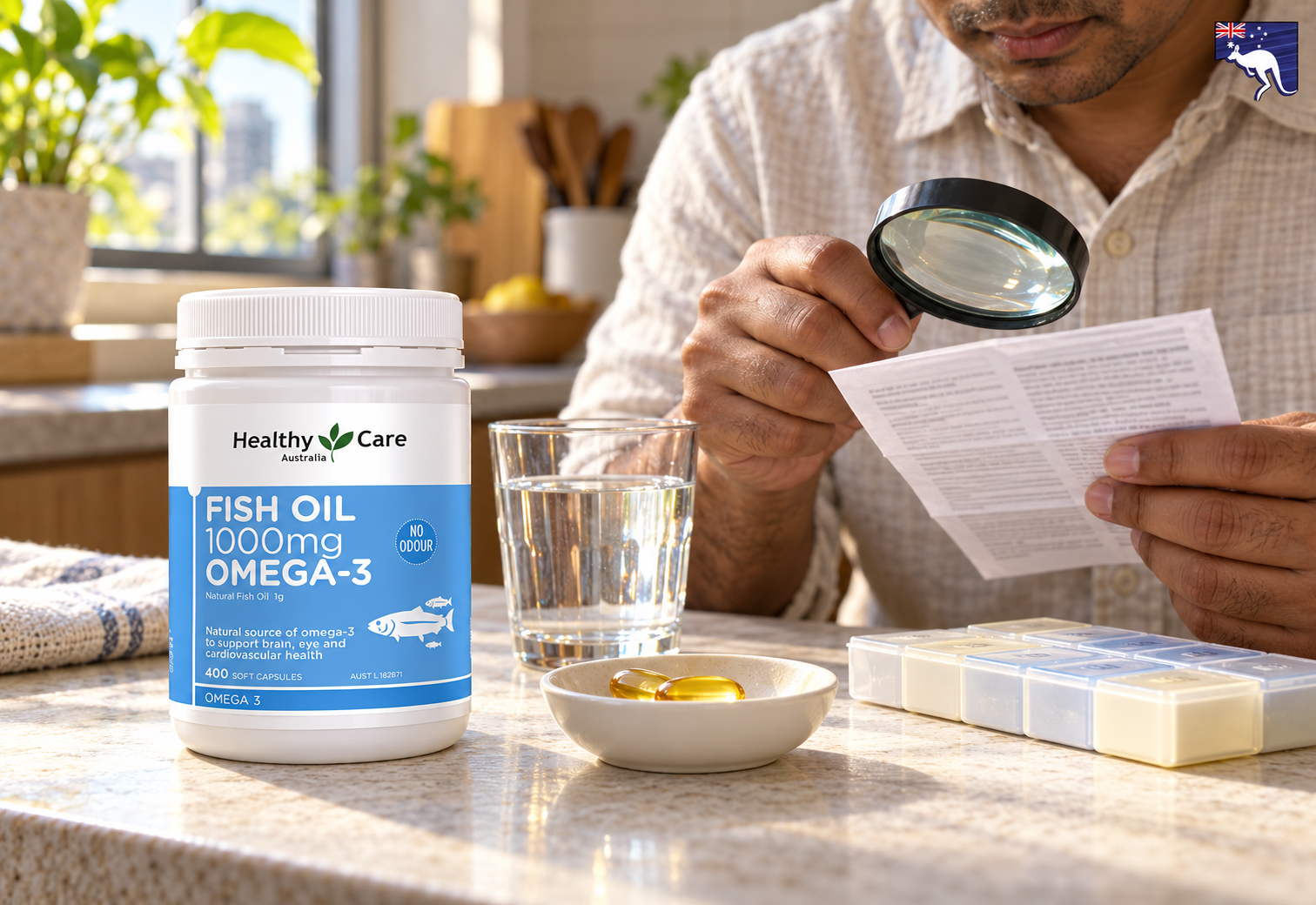
Healthy Care Fish Oil 1000mg Omega-3
Healthy Care Fish Oil 1000mg Omega-3 is an odourless fish oil supplement that provides essential Omega-3 fatty acids to support heart, brain, eye and joint health. It is a convenie...
Set up the bottle for everyday use
Choose a cool, dry storage place that meets the label's temperature limit. In Bangladesh, a car, sunny windowsill or shelf beside a cooker can make a convenient reminder spot unsuitable for storage. Use a phone reminder instead of leaving the bottle somewhere hot.
Retain the original packaging, batch details and expiry information. Check any after-opening instructions for liquids and do not assume refrigeration is suitable for every product. Our freshness and storage guide explains the quality questions in more detail.
Before ordering your next pack, confirm that the formulation has not changed. Compare the new label with the one your clinician or pharmacist reviewed, and use the related products to inspect the available strengths and sizes.