Omega-3 for Men and Women: Needs Across Life Stages
A men's or women's label does not explain which omega-3 product you need. Food intake, pregnancy, breastfeeding, medicines and the reason for supplementation matter more. This guide separates life-stage considerations from broad marketing promises and helps Bangladesh shoppers ask better questions.
Quick Answer
Men and women both need omega-3 fats, but there is no simple rule that men should choose EPA and women should choose DHA. Pregnancy and breastfeeding require additional attention to nutrition and product safety. For everyone, the appropriate decision depends on diet, health circumstances and the specific purpose of supplementation.
Key Takeaways
- Different dietary reference amounts for men and women do not translate directly into different fish-oil capsule counts.
- Pregnancy changes the safety discussion: cod liver oil and retinol-containing supplements should be avoided under NHS guidance.
- A product's women's, men's or over-50 label is not evidence that it treats hormonal symptoms or prevents memory decline.
A husband and wife can eat the same meals yet have different reasons for asking about fish oil. One may be planning a pregnancy; the other may have a concerning lipid report. Choosing two bottles labelled “women” and “men” would not resolve either question.

Start with the life stage and the intended outcome. That gives you a more useful basis for comparing omega-3 products than gendered packaging or a claim that one fatty acid belongs to one sex.
What do different nutrient requirements actually mean?
The US dietary reference values summarised by NIH set adult ALA adequate intakes at 1.6 g daily for men and 1.1 g for women. These are ALA values, not recommended EPA/DHA capsule doses. The same framework does not establish a separate EPA or DHA intake recommendation. See the NIH reference table.
That distinction prevents a common shopping mistake: seeing a larger number for men and assuming every man needs more fish-oil capsules. You need to know which nutrient the number describes before applying it to a bottle.
| Situation | Main question | Useful next step |
|---|---|---|
| Adult with no specific treatment goal | What does the usual diet provide? | Review food intake before choosing a supplement. |
| Planning pregnancy or pregnant | Does the product fit the maternity plan? | Review the complete label with the maternity clinician. |
| Breastfeeding | Are food choices and supplements appropriate together? | Discuss intake and any dietary restrictions. |
| Older adult or person taking medicines | What problem is being addressed, and does the product fit current care? | Review the purpose and medicines before purchase. |
Pregnancy: consider the whole product
Fish supplies more than omega-3. FDA/EPA guidance encourages people who are pregnant or breastfeeding to choose a variety of lower-mercury fish. Its “Best Choices” approach is a food-selection guide, not a conversion chart from fish meals to capsules. Read the FDA/EPA advice.
For a Bangladesh household, identify the fish species accurately when applying a foreign advisory. A familiar local name may not map neatly to every entry on a US chart. If you avoid fish, cannot tolerate it or have a restricted diet, take that information to your maternity appointment rather than guessing a supplement amount.
Avoid cod liver oil during pregnancy. NHS guidance also advises avoiding supplements containing vitamin A as retinol because excessive amounts can harm the baby's development. A fish-liver oil and an ordinary fish-oil product are not interchangeable simply because both mention omega-3. See NHS pregnancy supplement guidance.
Check whether a prenatal product already contains DHA or other overlapping ingredients. Our pregnancy and breastfeeding DHA guide addresses that decision in more detail.
Breastfeeding is a new review point
Do not assume that the routine chosen during pregnancy must continue unchanged indefinitely. Bring the prenatal supplement, any separate omega-3 and a brief description of your diet to your postnatal review. Ask what each product is contributing and whether you still need both.
The FDA/EPA food advice specifically includes breastfeeding. However, the fact that fish is recommended does not establish that every mother needs a retail capsule, or that a supplement replaces the other nutrients supplied by meals. Keep the food question and the product question visible as separate decisions.
Menopause and other “hormone balance” claims
A claim about women's wellness needs a named outcome. Hot flushes, menstrual symptoms, fertility and general dietary intake are different questions; evidence for one cannot establish all the others.
For example, a randomised trial of omega-3 for menopausal vasomotor symptoms found no significant advantage over placebo for hot-flush frequency after 12 weeks. This result concerns the intervention studied, but it is a clear reason not to promise that ordinary fish oil will relieve menopausal symptoms. Read the trial.
If you are buying for a persistent symptom, ask what evidence exists for that symptom and formulation. Do not let a supplement purchase postpone an assessment or replace an agreed treatment plan. A colourful “women's health” label cannot provide that assessment.
Men's health and older age: define the purpose
For a man considering omega-3, “heart,” “performance” and “fertility” are not equivalent goals. A clinician-directed treatment for a lipid problem is different from adding nutrients to a diet. Check the relevant question instead of assuming an EPA-heavy bottle is automatically the male option.
Older age also does not make a memory claim reliable. In the AREDS2 study population of older adults with age-related macular degeneration, omega-3 supplementation did not slow cognitive decline. That finding has a defined population and cannot answer every cognition question, but it does not support a guaranteed memory benefit. See the National Eye Institute's trial report.
For that specific concern, our memory and concentration guide separates nutrient roles from clinical results.
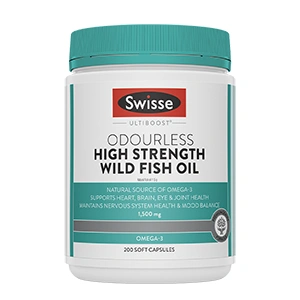
Swisse Ultiboost Odourless High Strength Wild Fish Oil
Swisse Ultiboost Odourless High Strength Wild Fish Oil is a premium Omega-3 supplement that supports heart health, brain function, healthy vision, and nervous system health. Its hi...
Make the purchase fit the person
Before ordering, write down the intended user, reason for purchase and any existing supplements or medicines. Then check the exact formulation, EPA/DHA amounts, other ingredients and warnings. If family members share one bottle, each still needs an appropriate reason and directions for use.
The FDA's consumer guidance explains that supplements can interact with medicines and should not replace prescribed treatment or a varied diet. Take the label to a pharmacist when that question is unresolved. Our selection guide covers the practical comparison once suitability is established.