Omega-3 and Fertility: Evidence for Men and Women Trying to Conceive
Fertility headlines often turn better sperm measurements or an association with pregnancy into a promise that fish oil will help couples conceive. This guide separates male and female evidence, explains the outcomes that matter, and places supplements within practical preconception care.
Quick Answer
Omega-3 is not a proven fertility treatment for men or women. Some studies report favourable sperm or pregnancy findings, but evidence is inconsistent and often observational or based on small trials. Better laboratory measurements do not guarantee conception or live birth. Review nutrition and supplements together, while arranging timely fertility assessment when needed.
Key Takeaways
- Sperm concentration, motility and hormone results are useful research measures, but live birth is a different outcome.
- A supplement association in an observational study cannot prove that the supplement caused a pregnancy.
- Do not postpone fertility assessment while completing repeated courses of fish oil or other supplements.
Trying to conceive can make every food choice and supplement feel consequential. One person hears that DHA improves sperm; another sees a claim about egg quality. Before buying omega-3 for fertility, it helps to separate a reasonable nutrition choice from a treatment shown to increase the chance of having a baby.

The evidence does not support a guaranteed result for either partner. That does not make the research irrelevant. It means the useful questions are specific: who was studied, what else were they taking, and was the outcome a laboratory measurement, pregnancy or live birth?
Three outcomes that fertility headlines often mix together
| Reported result | What it means | What to check next |
|---|---|---|
| Improved semen or hormone measure | A biological marker changed | Was pregnancy or live birth measured? |
| Higher conception or clinical pregnancy rate | More pregnancies were identified | Was the study randomised, and were other treatments used? |
| Higher live-birth rate | More participants had a baby born alive | Was the finding reliable and repeated? |
A finding at the first level should not be advertised as if it proves the third. Similarly, a study of couples having assisted treatment does not automatically describe what happens when a healthy couple starts a supplement at home.
Omega-3 for male fertility: sperm measures are not the whole answer
Research has examined fish oil and sperm concentration, movement and shape. Results have not been consistent enough to promise improvement. A systematic review published in 2025 assessed randomised supplement trials and did not find improvement in sperm parameters from omega-3. Across the wider supplement evidence, the authors called for stronger studies focused on pregnancy outcomes. Read the 2025 review.
This is a useful correction to older headlines that present one positive semen study as settled advice. The review is not proof that every possible omega-3 formulation has no effect. It does mean that “improves sperm quality” is too confident as a general product claim.
The AUA/ASRM male infertility guideline likewise considers the clinical usefulness of supplements uncertain and says the evidence does not support recommending particular agents. It emphasises evaluation for treatable causes of infertility. See the specialist guideline.
For a man with an abnormal semen result, the next step is interpretation in context, not choosing the highest-strength capsule. Ask what the finding means, whether repeat assessment is appropriate, and whether a specific cause has been identified. Keep copies of reports so a change is assessed using comparable information.
Omega-3 for female fertility: association is not proof
A 2022 prospective study followed women trying to conceive naturally. Self-reported omega-3 supplement use was associated with a higher probability of conception in some analyses. However, this was not a randomised trial. Supplement users could differ in diet, other supplements and health behaviours, and the study did not establish a dose-response relationship. Read the original fecundability study.
The association weakened after accounting for prenatal or multivitamin use. In an analysis limited to women taking those products, the estimate was compatible with no clear difference. That nuance is lost when the study is shortened to “fish oil boosts fertility.”
The sensible interpretation is that the finding supports further research. It cannot tell an individual woman how much to take, how quickly she will conceive, or whether a particular bottle improves egg quality. A naturally conceived pregnancy after starting a supplement also does not establish that the supplement caused it.
What if PCOS or fertility treatment is involved?
A small 2023 randomised trial studied omega-3 alongside clomiphene in women with PCOS-related ovulation difficulties. It included 34 women and 60 treatment cycles; the reported clinical-pregnancy advantage was significant in an overweight or obese subgroup. It did not establish that fish oil alone improves fertility or demonstrate a general live-birth benefit. See the original PCOS trial.
Results from an add-on study belong within the treatment setting in which they were observed. They are not an instruction to self-start ovulation medicines or reproduce a research supplement schedule. Tell your fertility team about every product you use, including anything described as natural, herbal or nutritional.
When should couples seek assessment?
ASRM recommends the following timing when pregnancy has not occurred with regular unprotected intercourse. These are international specialist recommendations, not a separate Bangladesh-specific protocol; your history may warrant earlier care. Read the evaluation guidance.
| Age of the woman | Usual assessment timing |
|---|---|
| Under 35 | After 12 months of trying |
| 35 or older | After 6 months of trying |
| Over 40 | More immediate assessment may be appropriate |
Seek advice sooner when there is a known concern, such as absent or very irregular periods or a history associated with infertility. Assessment should consider both partners when applicable. An appointment is an opportunity to understand the situation; it does not commit you to a particular treatment.
For couples in Bangladesh, travel, appointment availability and test costs may need planning. Use the time to collect menstrual dates, previous reports and a complete medicine list. Do not restart the waiting period each time someone recommends a new supplement course.
Preconception nutrition has a wider purpose
Preparing for pregnancy includes reviewing existing conditions, medicines and nutrition. ACOG/ASRM guidance recommends reviewing both prescribed and nonprescribed products, including supplements, and encourages folic acid before pregnancy to reduce neural-tube-defect risk. Omega-3 is not a replacement for that discussion or for an appropriate prenatal plan. See preconception counselling guidance.
Pregnancy DHA guidance answers a different question from whether a supplement increases fertility. After a positive test, arrange a review of your complete product list rather than assuming everything used while trying remains appropriate. The pregnancy and breastfeeding omega-3 guide covers that later stage.
How to make a practical supplement decision
If you and your clinician decide there is a nutritional reason to use omega-3, compare labels rather than fertility slogans. Record the EPA and DHA amount per serving, serving size and any additional ingredients. The large number on the front may describe total fish oil rather than the amount of EPA plus DHA.
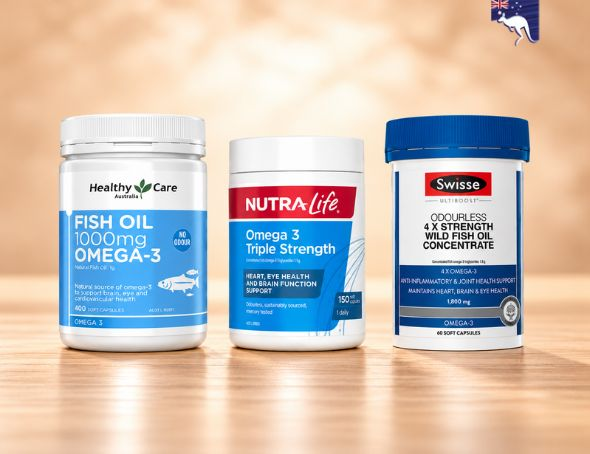
Compare only like-for-like servings. A cheaper bottle may contain more capsules but a different amount in each one. Conversely, a concentrated product is not automatically better for conception. No brand in a shop comparison should be treated as a proven fertility medicine.
- Write down why you are considering it: dietary intake, a clinician's recommendation, or an advertised fertility claim.
- Bring the full ingredient panel, not just a front-label photograph, to your appointment.
- Include both partners' existing supplements when checking for duplication.
- Agree whether there is a meaningful outcome to review and when to review it.
Avoid building a large stack simply because each ingredient has a plausible biological role. The cost and complexity are real even when the benefit is uncertain. Keep the next clinical step on the calendar, and judge the plan by evidence and your priorities rather than by the number of products involved.

Nutra life Omega 3 Triple Strength
Nutra-Life Omega 3 Triple Strength is a high-potency fish oil supplement that supports heart health, healthy brain function, and eye health. Each soft capsule delivers 900 mg of Om...