Omega-3 Benefits for Skin: Dryness, Acne and What the Evidence Shows
A supplement can look like an easy answer when your skin feels dry or breakouts keep returning. This guide separates promising omega-3 research from established skin care, then explains what to check before spending money on fish oil.
Quick Answer
Omega-3 benefits for skin are still being studied. Small acne studies suggest possible improvement, but they do not establish fish oil as a standard treatment or prove that every product works. Evidence is insufficient to recommend fish oil for eczema. For dryness, gentle cleansing and regular moisturising remain practical first steps.
Key Takeaways
- Acne improvement in a small study is encouraging evidence, not a guarantee of clearer skin.
- Dryness, acne and eczema are different problems and need different care.
- Choose a supplement by its actual ingredients and suitability, not a promise of glowing or lighter skin.
Skin that feels tight after washing and skin with recurring pimples can lead to the same shopping search: “Will fish oil help?” The useful answer starts with what is happening to your skin, rather than which bottle has the strongest number on the front.
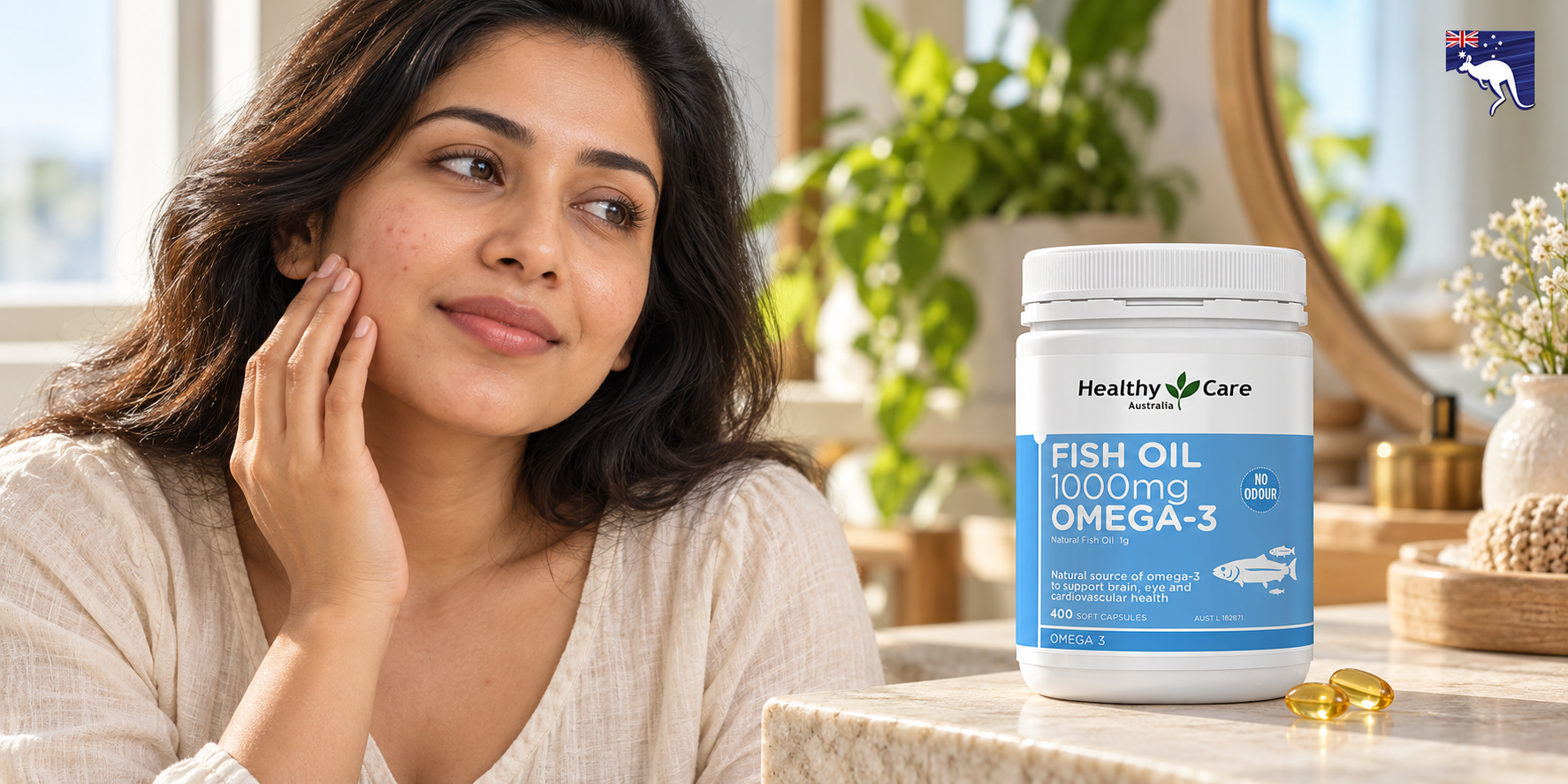
There is research worth knowing about. There are also limits that a good product description should make clear. Neither a photograph of smooth skin nor a customer's before-and-after story can show what a supplement will do for you.
Can omega-3 help acne?
A 2014 randomised trial enrolled 45 people with mild to moderate acne. Over 10 weeks, the researchers compared an EPA/DHA group, a gamma-linolenic-acid group and a control group. Acne lesions decreased in the supplemented groups. The omega-3 arm used 2,000 mg of EPA plus DHA daily.
That is a research dose, not an instruction to take that amount. With a small study and a short follow-up, questions remain about who benefits, how durable any improvement is and which formulations are comparable.
In a 2024 study of 60 people, acne improved during a 16-week programme combining a Mediterranean-style diet with algae-derived EPA and DHA. Because diet and supplementation changed together without a separate control group, the study cannot isolate the effect of omega-3. It also does not prove that a particular fish-oil brand produces the same result.
For persistent acne, discuss established options with a dermatologist. The American Academy of Dermatology's acne guideline supports treatments including benzoyl peroxide and topical retinoids, with other medicines chosen according to the person's needs. Fish oil should not delay assessment of painful, scarring or distressing acne.
What about dry skin and eczema?
“Dry skin” describes a symptom, not one diagnosis. Skin may feel uncomfortable after harsh cleansing, during a dry season or in an air-conditioned room. Persistent itching, cracked patches or a recurring rash deserves an assessment rather than a supplement experiment.
Evidence for one skin condition cannot simply be transferred to another. The NCCIH review of complementary approaches reports inconsistent or insufficient evidence to recommend fish oil for atopic dermatitis, a common form of eczema. A plausible effect on inflammation is not the same as proof that capsules will treat an eczema flare.
For everyday dryness, the AAD's practical skin-care guidance favours short, warm showers, gentle fragrance-free products and moisturiser applied while the skin is still damp. A cream or ointment may be more useful than a thin lotion when dryness is troublesome. Seek care if these measures do not help.
Match the question to a realistic next step
| Your main concern | What the evidence means for your decision |
|---|---|
| Occasional tightness or dryness | Review cleanser, shower habits and moisturiser before assuming an omega-3 deficiency. |
| Persistent acne | Discuss a treatment plan. Small supplementation studies do not establish a standard acne dose. |
| Diagnosed eczema | Continue the care plan agreed with your clinician; fish oil is not an established replacement. |
| “Glow,” fairness or removal of acne marks | The studies discussed here do not establish these advertised outcomes. |
How to compare fish oil for skin in Bangladesh
If you and your clinician decide an omega-3 supplement is appropriate for your overall diet, choose on the basis of the label. Look for the separate EPA and DHA amounts and whether they apply to one capsule or a full serving. “Fish oil 1,000 mg” does not necessarily mean 1,000 mg of those two fatty acids.
Compare the full ingredient list, capsule size, allergy warnings, pack size and current price. Ask for photographs of the available bottle when a listing is unclear. Buying a larger or more concentrated bottle does not create stronger evidence for acne or dryness.
The product shown below lets you inspect a current fish-oil formulation. It is not presented as an acne medicine, an eczema treatment or a clinically tested skin-care brand.

Healthy Care Fish Oil 1000mg Omega-3
Healthy Care Fish Oil 1000mg Omega-3 is an odourless fish oil supplement that provides essential Omega-3 fatty acids to support heart, brain, eye and joint health. It is a convenie...
Keep the routine simple enough to judge
Starting a new cleanser, serum, diet and supplement in the same week makes it difficult to identify what helped or irritated your skin. Write down your current routine and discuss planned changes if you are already receiving treatment. Consistent photographs under similar lighting can help you describe changes at an appointment, but they do not replace a clinical assessment.
There is no reliable promise that fish oil will improve your skin in a fixed number of days. The studies above lasted weeks, and their timelines are not a countdown to results for an individual customer. Do not keep raising the dose because a promised “glow” has not appeared.
Before using supplements alongside acne medicines, share the full product labels with your pharmacist or dermatologist. This is particularly important when considering cod liver oil or a combination product with added vitamins. Our safety guide explains the broader interaction questions; the dry-skin guide below focuses on the products you apply directly.