Magnesium vs Calcium – Which Is Better for Bones & Muscles?
Calcium vs Magnesium is not a competition but a partnership. This blog explains how these two essential minerals work together for bone strength, muscle relaxation, sleep, and nerve health in Bangladesh. Learn deficiency signs, who needs which mineral more, ideal balance, and smart supplement choices for long-term health.
In Bangladesh, we're taught from childhood: "Drink milk for strong bones." Calcium is the hero of bone health. But what if we told you there's an equally important, often overlooked mineral that acts as its partner? This is the great debate: Magnesium vs. Calcium. One is the "gas pedal" for your muscles, the other is the "brake." Using one without the other is like driving a car with no way to stop.
Calcium's Role: The "Brick" for Your Body's Structure
Calcium is the most abundant mineral in your body, and for good reason. Think of it as the primary building block, the literal "brick" that constructs the strong framework of your skeleton and teeth. Its main job is to provide structural integrity.
But Calcium has a second, equally vital role: it is the trigger for contraction. When a nerve sends a signal to a muscle, whether it's your bicep or your heart, it's a flood of calcium ions into the muscle cells that causes them to tighten and contract.
- Primary Function: Bone and tooth formation.
- Secondary Function: Muscle contraction, nerve signaling, blood clotting.
- Analogy: It’s the "Gas Pedal" or the "On Switch."
In Bangladesh, we get calcium from sources like milk, yogurt (*doi*), and especially small indigenous fish (*Mola, Dhela*) that are eaten whole with their bones. However, getting enough to prevent bone loss after age 40 can be challenging through diet alone. For more on this, read our guide on bone health supplements.
Magnesium's Role: The "Relaxer" and Master Regulator
If Calcium is the "On Switch," Magnesium is the indispensable "Off Switch." After calcium has done its job contracting a muscle, magnesium steps in to actively pump the calcium out, allowing the muscle to relax. Without magnesium, your muscles would remain permanently tense.
Its role is far more extensive than just muscle relaxation. Magnesium is a co-factor in over 300 enzymatic reactions in the body. It helps convert food into energy (ATP), regulates neurotransmitters for calm and sleep, and crucially, it controls how your body uses calcium.
- Primary Function: Muscle relaxation and enzymatic reactions.
- Secondary Function: Regulating calcium levels, energy production, nerve function, blood pressure control.
- Analogy: It’s the "Brake Pedal" or the "Off Switch."
Unfortunately, modern diets and soil depletion mean that magnesium-rich foods like leafy greens (*lal shak*), pumpkin seeds (*mishti kumrar bichi*), and nuts are often not enough to meet the demands of a high-stress urban lifestyle, making deficiency common. This is a key reason for frequent muscle cramps in Bangladesh.
The Critical Teamwork: Why You Can't Choose Just One
The question "which is better" is flawed. They are a team, and their balance is everything. Here’s how they work together:
For Your Bones
Magnesium activates Vitamin D. Without active Vitamin D, your body cannot absorb calcium from your food. Furthermore, magnesium stimulates a hormone called calcitonin, which draws calcium out of the blood and soft tissues and directs it back into the bones. Without enough magnesium, supplemental calcium can end up in the wrong places, like your arteries or kidneys.
For Your Muscles
The relationship is a perfect push-pull rhythm. Calcium flows in to contract the muscle fiber, and magnesium flows in to relax it. An imbalance disrupts this rhythm. Think of it as a constant tug-of-war; if Team Calcium is too strong and Team Magnesium is weak, you get stuck in a state of tension.
Warning Signs: What Happens When They Are Out of Balance?
For many people, especially those taking only calcium supplements, the ratio is heavily skewed. This leads to a state of "relative magnesium deficiency."
Signs of Too Much Calcium Relative to Magnesium:
- Muscle Cramps & Spasms: The #1 sign. Your muscles can't relax.
- Twitching Eyelids: A classic sign of magnesium insufficiency.
- Anxiety and Irritability: Magnesium helps calm the nervous system.
- Constipation: Calcium tenses intestinal muscles; magnesium relaxes them.
- Trouble Sleeping: Inability to "switch off" at night.
When Should You Focus More on Calcium?
While balance is key, certain groups have higher calcium requirements to prevent structural decline. You should prioritize a quality calcium supplement if you are:
- A Woman Over 40: Bone density declines rapidly after menopause. Calcium is crucial for women in this age group.
- Diagnosed with Osteopenia or Osteoporosis: To slow bone loss and reduce fracture risk.
- Someone with a Low-Dairy Diet: If you avoid milk and yogurt, you may need a supplement.
- A Growing Teenager: To build peak bone mass for life.
When Should You Focus More on Magnesium?
Magnesium deficiency is one of the most common mineral deficiencies in the modern world. You should prioritize a quality magnesium supplement if you:
- Experience Frequent Muscle Cramps or Spasms: Especially night-time leg cramps.
- Live a High-Stress Life: Your body burns through magnesium rapidly when under stress.
- Suffer from Poor Sleep or Anxiety: Magnesium is nature's calming mineral.
- Are Physically Active: You lose magnesium through sweat.
- Have High Blood Pressure or Diabetes: Magnesium plays a key role in cardiovascular health and glucose control.
Top 4 Mineral Picks: Structure vs. Function
Choose the right tool for the job: Calcium for bone strength, Magnesium for muscle relief.
1) Structural Support: The Best Calcium Formulas
What they do: These provide the "bricks" for your skeleton. Both formulas use high-quality calcium combined with natural Vitamin D3 to ensure absorption into the blood, not just digestion.
- Swisse (Left): The premium standard. Best for those with sensitive stomachs or needing guaranteed potency.
- Healthy Care (Right): The high-value family choice. A larger bottle that makes daily consistency affordable.
- How to take: 2-3 tablets daily with food (breakfast or dinner).
Don't wait for a fracture. Building bone density is a daily investment—pick the bottle that fits your budget so you never skip a day.


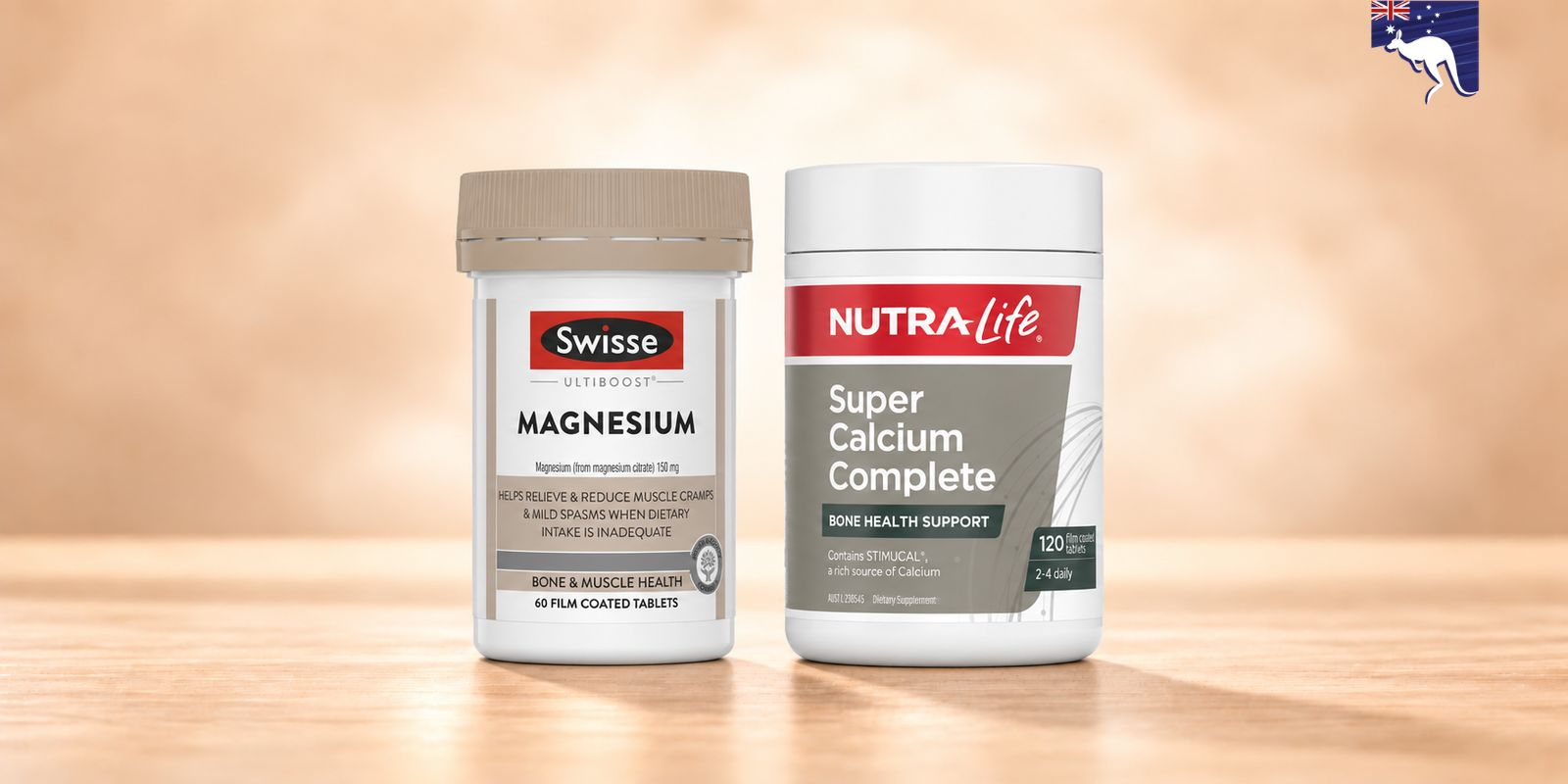
2) Muscle & Nerve Support: High-Absorption Magnesium
What they do: These act as the "off switch" for tight muscles. If you suffer from night cramps ("rog e tan"), twitching eyes, or stress-related insomnia, these are your best friends.
- Healthy Care (Left): The "Bio" specialist. Designed specifically for rapid absorption to stop cramps fast. Ideally taken with dinner.
- Swisse (Right): The "Sleep" specialist. Combines Magnesium with Passionflower to relax the body AND calm the mind for better sleep.
- How to take: 1-2 tablets daily, 30-60 minutes before bed.
Painful cramps ruin your sleep quality. A single dose before bed can break the cycle of pain and fatigue overnight.


Quick Comparison Table: Calcium vs. Magnesium
| Feature | Calcium | Magnesium |
|---|---|---|
| Main Role | Structure (Bones), Contraction | Relaxation, Regulation, Energy |
| Analogy | The "Brick" / "Gas Pedal" | The "Mortar" / "Brake Pedal" |
| Deficiency Signs | Weak bones, brittle nails (long-term) | Muscle cramps, twitches, anxiety, fatigue (short-term) |
| Best For | Women 40+, low-dairy diets, osteoporosis | High stress, athletes, poor sleep, cramps |
| Local Food Sources | Small fish, milk, yogurt (*doi*) | Leafy greens (*shak*), pumpkin seeds, nuts |
Frequently Asked Questions (FAQs)
1. Can I take magnesium and calcium supplements together?
Yes, you can, especially in balanced formulas. However, if taking high doses of each, it's often recommended to take them a few hours apart, as they can compete for absorption in the gut. A common strategy is calcium in the morning and magnesium at night to aid sleep.
2. What is the ideal ratio of calcium to magnesium?
The old recommendation was a 2:1 ratio of calcium to magnesium. However, because modern diets are often high in calcium (from dairy) and very low in magnesium, many nutrition experts now suggest a 1:1 ratio is more appropriate to correct the imbalance.
3. Which is more important for sleep and relaxation?
Magnesium is the clear winner. It helps calm the nervous system by regulating the neurotransmitter GABA, which promotes relaxation and sleep. Calcium's primary role is contraction, not relaxation.
Related Topics:
References & Scientific Sources
The information in this article on the synergistic relationship between Calcium and Magnesium is supported by established nutrition science and global health authorities.
- National Institutes of Health (NIH) – Magnesium Fact Sheet for Health Professionals
- National Institutes of Health (NIH) – Calcium Fact Sheet for Health Professionals
- The Importance of the Magnesium to Calcium Ratio (Journal of the American College of Nutrition)
Medical Disclaimer
The information provided in this blog post is for general informational purposes only and does not constitute medical advice. It is not intended to diagnose, treat, cure, or prevent any disease. Always consult with a qualified healthcare professional before starting any new supplement regimen. Australian Goods Bangladesh is a retailer of health products and not a medical service provider.