Probiotics for Kids in Bangladesh: Age, Uses and Safety
What should a parent do when a child has diarrhoea, starts an antibiotic or simply wants the same gummy as a sibling? Compare age instructions, clinical evidence and the label details that matter.
Quick Answer
A healthy child usually has no reason to take a probiotic every day. For sudden watery diarrhoea, offer oral rehydration solution and watch for dehydration. If a clinician recommends a probiotic for a particular reason, check the exact strain, the age range and how the product should be given.
Key Takeaways
- For acute watery diarrhoea, prioritise fluids and follow WHO guidance on ORS.
- A clinician may recommend a particular strain when a child starts certain antibiotics.
- An age limit, a safe way to take the product and suitable storage all matter when comparing packs.
A parent buying probiotics for kids faces two quite different decisions. Is there a reason for this child to take one? And can they safely use the product on the shelf? A chewable that suits a schoolchild may be wrong for a toddler. If your child has diarrhoea today, start by checking whether they can drink and pass urine normally. Choosing a supplement can wait.
Does a healthy child need a daily probiotic?
There is no general recommendation for healthy children to take a daily probiotic. If your child is growing well, eats a range of foods and has no particular symptoms, you do not need to find a supplement just because another family uses one. Plain doi made from pasteurised milk, if age-appropriate and tolerated, can be an ordinary part of a meal. A food and a prescribed course of a particular strain serve different purposes. NIH guidance on probiotic use.
What changes if your child has diarrhoea?
For sudden watery diarrhoea, offer oral rehydration solution (ORS) to replace lost water and salts. Mix an ORS packet with exactly the amount of safe water printed on that packet. Offer small, frequent sips and continue breastfeeding or usual age-appropriate feeds. Ask a clinician or pharmacist about zinc. For children up to 10 years old with acute watery diarrhoea, the World Health Organization suggests against using probiotics. WHO childhood diarrhoea guideline.
Seek urgent care if your child is too sleepy to drink, cannot keep fluids down, is passing very little urine or has blood in the stool. An infant who is drinking poorly needs prompt assessment. Bring along the medicines and supplements you have already given. WHO advice on diarrhoea and dehydration.
A different question comes up when a child starts an antibiotic and a parent hopes to prevent diarrhoea. The European paediatric gastroenterology society, ESPGHAN, supports considering particular organisms, including Lacticaseibacillus rhamnosus GG or Saccharomyces boulardii, for some children with risk factors. A similar-sounding name on a gummy does not establish the same benefit. Ask the prescriber whether your child would benefit, and which preparation and duration they mean. ESPGHAN’s paediatric position paper.
What if the problem is constipation or colic?
A probiotic studied during antibiotics tells you very little about a child who is passing hard, painful stools. ESPGHAN’s review found too little benefit to recommend the probiotics studied for childhood functional constipation. If your child puts off going to the toilet because it hurts, tell their clinician how long that has been happening and what the stools look like. That detail is more useful than a list of supplements you have considered.
For infant colic, the research is narrower still. Some studies of particular strains found a benefit in breastfed babies. The same guidance could not make a recommendation for those strains in formula-fed babies. If crying is new or distressing, speak to your baby’s clinician before trying a product meant for older children. ESPGHAN guidance on colic and constipation.
What age is the product actually for?
There is no single starting age across drops, powders, chewables and gummies. Before giving an infant any probiotic, discuss the reason and the actual product with their paediatrician. Premature babies, seriously ill children and children with weakened immunity need individual medical advice because live organisms can sometimes cause serious infections. FDA safety notice on preterm infants.
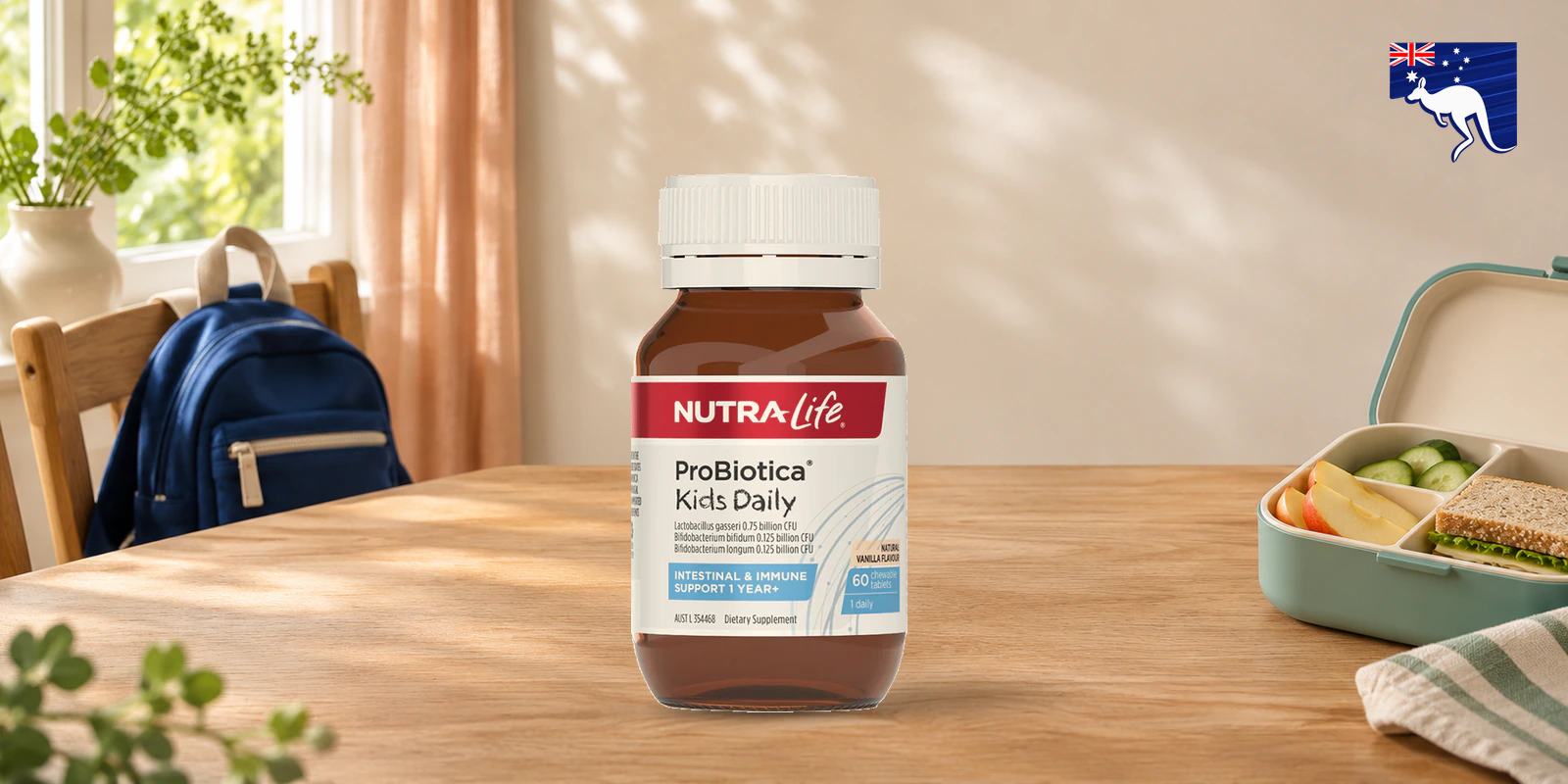
For toddlers, the directions sometimes change with age even within one pack. The Australian Nutra-Life ProBiotica Kids Daily instructions say to crush the tablet into cool food or liquid for ages two to three, while the directions for children aged three and over describe chewing it with food. Check the exact pack you have. If your child has trouble chewing, ask for another suitable form before giving a whole tablet. Nutra-Life Australia’s age-specific directions.
Little Swisse Prebiotic + Probiotic Gummies illustrate another detail. Swisse lists two gummies per daily serving and says children should chew them under adult supervision. Its declared two billion CFU applies to the daily serving. Keep gummies beyond a child’s reach between servings, as you would any product they might mistake for sweets. Little Swisse serving and supervision instructions.

Nutra life Probiotica Kids Daily
Nutra-Life Probiotica Kids Daily is a children’s probiotic supplement formulated to support healthy gut microflora, digestive health and immune system function. Its vanilla-flavour...
How can you mix a probiotic into food?
If the pack allows mixing with cool food, put a small portion of something your child already eats, such as plain doi or mashed banana, into a separate bowl. Stir the product into that portion and offer it straight away. Mixing it through an entire bowl of breakfast makes it hard to tell how much your child has taken if they leave half behind.
If some spills or your child spits it out, ask the pharmacist what to do before offering any more. Keep the original pack handy so that a grandparent or another caregiver can check the same preparation instructions. Children’s Minnesota guidance on mixing with food.
What should a parent check before buying in Bangladesh?
- Match the name. If the paediatrician specified a strain such as GG, look for those letters as well as the species name. Ask the pharmacist if you cannot tell whether two names match.
- Read the serving and ingredients. CFU means colony-forming units, a measure of viable microorganisms. A larger total tells you little about whether the formula suits your child. Check ingredients carefully if they have a food allergy.
- Check the date and storage limit. An imported bottle may be labelled shelf-stable and still require storage below a stated temperature. Ask how it was transported and look at the seal and expiry date before opening it.
If you are standing at the pharmacy counter with several choices, show the pharmacist your child’s age, current medicines and the name of the strain, if one was recommended. That is enough to start a more useful conversation than asking for the strongest bottle.