
Swisse vs Healthy Care Ashwagandha in Bangladesh: Dose & Price
Choosing between Swisse and Healthy Care ashwagandha in Bangladesh? This guide compares three Australian formulas, their label doses, current 60-tablet prices and cost per day, so you can understand the differences before buying.
Quick Answer
At prices checked on 19 October 2026, Healthy Care High Strength costs ৳90 per day, versus about ৳107 for Swisse High Strength and ৳143 for Swisse Calm+. Swisse High Strength uses KSM-66 and needs one tablet daily; Healthy Care needs two. Calm+ adds magnesium, passionflower and reishi. These differences do not prove that one works better for everyone.
Key Takeaways
- Swisse High Strength and Swisse Calm+ are different formulas. High Strength uses KSM-66; Calm+ combines ashwagandha with magnesium, passionflower and reishi.
- Healthy Care’s 13,500 mg figure is a dry-root equivalent per tablet, not 13,500 mg of extract. Compare extract amount, label dose and formula together.
- A 60-tablet bottle lasts 60 days for Swisse High Strength, but 30 days for Healthy Care High Strength or Swisse Calm+ at the adult label doses.
- Ashwagandha is unsuitable during pregnancy or breastfeeding and for people with current or previous liver problems. Check medicines and other health conditions with a healthcare professional.
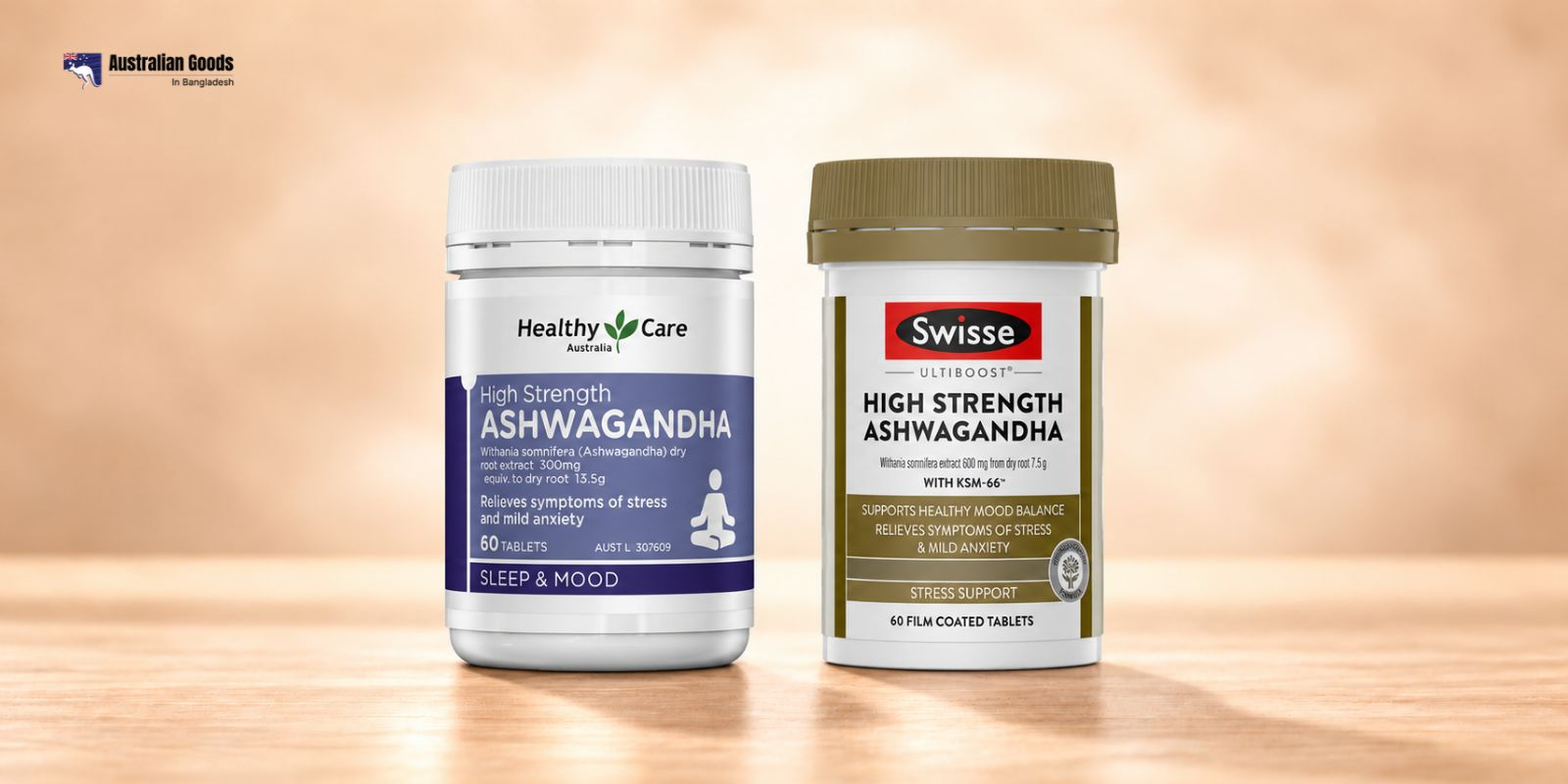
The useful question is not simply which brand has the biggest milligram number. It is which exact formula, daily serving and price you are comparing. This guide covers Healthy Care High Strength Ashwagandha, Swisse High Strength Ashwagandha and Swisse Ashwagandha Calm+.
Swisse vs Healthy Care: the formula differences
Healthy Care and Swisse High Strength are single-herb ashwagandha formulas. Swisse Calm+ is a blend. The table below uses the current Australian manufacturer information; follow the directions on your supplied pack.
| Product | Ashwagandha extract per tablet | Adult label dose | Days in a 60-tablet pack |
|---|---|---|---|
| Healthy Care High Strength | 300 mg dry-root extract; equivalent to 13.5 g dry root | 2 tablets daily, or as professionally directed | 30 days |
| Swisse High Strength | 600 mg KSM-66 extract; derived from 7.5 g dry root | 1 tablet daily with food | 60 days |
| Swisse Calm+ | 30 mg extract; equivalent to at least 1.5 g dry root; 1.5 mg withanolides | 2 tablets daily during or immediately after a meal | 30 days |
Calm+ also supplies 52.5 mg magnesium per tablet, plus passionflower and reishi extracts. Its smaller ashwagandha amount does not make it a direct substitute for either single-herb formula. The current Calm+ page does not identify its extract as KSM-66.

Swisse Ultiboost Ashwagandha Calm+
Swisse Ultiboost Ashwagandha Calm+. Compare ingredients, labelled serving, pack value and current Bangladesh price. Read suitability and medicine warnings.
Does 13,500 mg mean stronger than 600 mg?
No: dry-root equivalent and extract weight are different measurements. Healthy Care’s 13,500 mg figure describes the equivalent starting dry root. The actual extract in one tablet is 300 mg. Swisse’s 600 mg figure describes the extract itself.
At their adult label doses, both High Strength products supply 600 mg of extract per day. That does not make the extracts interchangeable: their specifications differ. A larger dry-root equivalent alone cannot show better absorption or stronger results.
Withanolides are compounds that may be used to standardise an extract. Calm+ states a withanolide amount. The two High Strength manufacturer pages reviewed do not state a withanolide percentage, so this guide does not assign either an assumed percentage or a potency ranking.
Compare the current labels for these two single-herb High Strength formulas:

Healthy Care High Strength Ashwagandha
Healthy Care High Strength Ashwagandha is an Australian-made herbal supplement for adults, formulated to help relieve symptoms of stress and mild anxiety and support the body’s abi...

Swisse Ultiboost High Strength Ashwagandha
Swisse Ultiboost High Strength Ashwagandha. Compare ingredients, labelled serving, pack value and current Bangladesh price. Read suitability and medicine warnings.
Bangladesh prices and cost per day
These are Australian Goods prices checked on 19 October 2026, using 60-tablet packs and the adult label doses above. They exclude delivery and are not a Bangladesh-wide price survey. Follow each product link for its current price and availability.
| 60-tablet product | Price checked | Daily cost |
|---|---|---|
| Healthy Care High Strength Ashwagandha | ৳2,700 | ৳90.00 |
| Swisse High Strength Ashwagandha | ৳6,400 | ৳106.67 |
| Swisse Ashwagandha Calm+ | ৳4,280 sale price | ৳142.67 |
Calculation: daily cost = pack price ÷ days per pack. For example, ৳6,400 ÷ 60 = about ৳106.67 per day. A lower bottle price can be misleading when one bottle lasts 30 days and another lasts 60.
For a 60-day price comparison, two Healthy Care bottles would cost ৳5,400, versus ৳6,400 for one Swisse High Strength bottle. The difference is ৳1,000 at these prices. This compares spending, not equivalent clinical benefit or a recommended treatment duration.
Which option fits your priorities?
- Lower daily spending: Healthy Care High Strength is the lowest-cost option among these three packs at the prices checked.
- A named extract and fewer tablets: Swisse High Strength offers KSM-66 and a one-tablet daily serving.
- A multi-ingredient formula: Calm+ includes magnesium, passionflower and reishi. Check whether you need those ingredients and whether they overlap with other products.
- Vegan preference or allergens: Swisse identifies Calm+ as vegan. High Strength is vegetarian but not vegan and lists lactose, milk products and soya beans. Healthy Care’s page does not confirm vegan status; check the physical pack rather than assuming.
There is no universal winner for stress or sleep. Product choice also depends on medicines, health conditions and tolerance. A pharmacist can help assess those factors before you buy.
What can you realistically expect?
NCCIH reports that some ashwagandha preparations may help with stress or insomnia, but studies are often small and use different preparations. Evidence for anxiety remains unclear. That does not establish that one of these retail products works better than another.
A supplement should not replace assessment or prescribed treatment for persistent anxiety or sleep problems. For the broader evidence and practical precautions, read our ashwagandha uses, safety and selection guide.
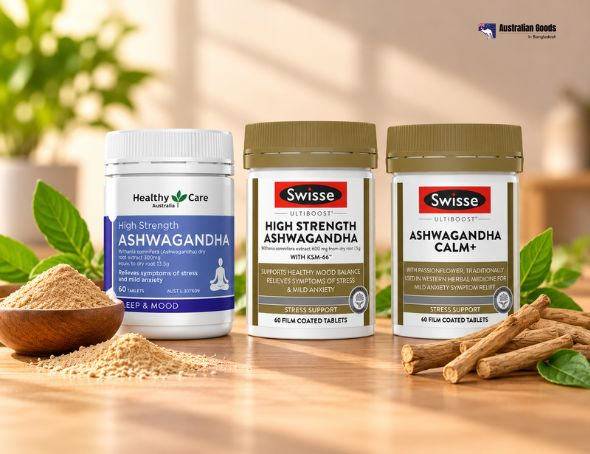
Who should avoid ashwagandha or check first?
- Avoid use during pregnancy or breastfeeding, or if you have current or previous liver problems. The TGA warns of very rare liver injury that can be serious.
- Ask a healthcare professional first if you have a thyroid or autoimmune disorder, hormone-sensitive prostate cancer, or upcoming surgery.
- Check medicine interactions: these include sedatives, anticonvulsants, thyroid medicines, immunosuppressants and medicines for blood pressure or diabetes.
- Stop and seek medical advice for yellow skin or eyes, dark urine, vomiting, nausea, unusual tiredness or weakness, stomach pain or loss of appetite. Sudden vomiting or diarrhoea can also occur after only one or two doses.
Drowsiness and stomach upset are possible. Long-term safety is not established; NCCIH describes short-term safety information for up to about three months. Do not combine ashwagandha products or extend use indefinitely without professional advice.
Before buying and storing your bottle
Check the exact formula and pack size, adult directions, allergens, expiry date, batch details and seal. Compare the supplied label with the current listing. Review delivery and return information before checkout, and ask for clarification if the label differs.
Storage limits also differ: the manufacturer pages state below 25°C for both Swisse formulas and below 30°C for Healthy Care. Keep the bottle dry and away from heat and direct sunlight. In a hot room, check whether your storage area stays within the label limit.
You can review the three linked product pages above or browse the ashwagandha range in Bangladesh. The products in this comparison are alternatives to assess, not a suggested combination to take together.