
Ashwagandha in Bangladesh: Benefits, Uses & Side Effects
Considering ashwagandha for stress or sleep? This guide explains the evidence, important safety warnings and practical label checks for shoppers in Bangladesh. Learn how extract strength, daily servings and extra ingredients affect your choice before comparing products.
Quick Answer
Some ashwagandha preparations may help stress and sleep, but results vary and long-term safety is uncertain. Choose by the exact extract, daily serving and suitability—not the largest milligram number. Avoid use during pregnancy or breastfeeding and with current or previous liver problems. Check medicines and medical conditions with a healthcare professional before starting.
Key Takeaways
- Ashwagandha evidence depends on the preparation studied; benefits for stress or sleep cannot be assumed for every supplement.
- Compare extract milligrams, plant-equivalent amounts and the labelled daily serving separately. A larger front-label number does not prove a stronger effect.
- Follow the product’s timing and food directions. Combining ashwagandha products can duplicate herbs and other active ingredients.
- Avoid ashwagandha during pregnancy or breastfeeding and with current or previous liver problems. Thyroid conditions and regular medicines need professional review.
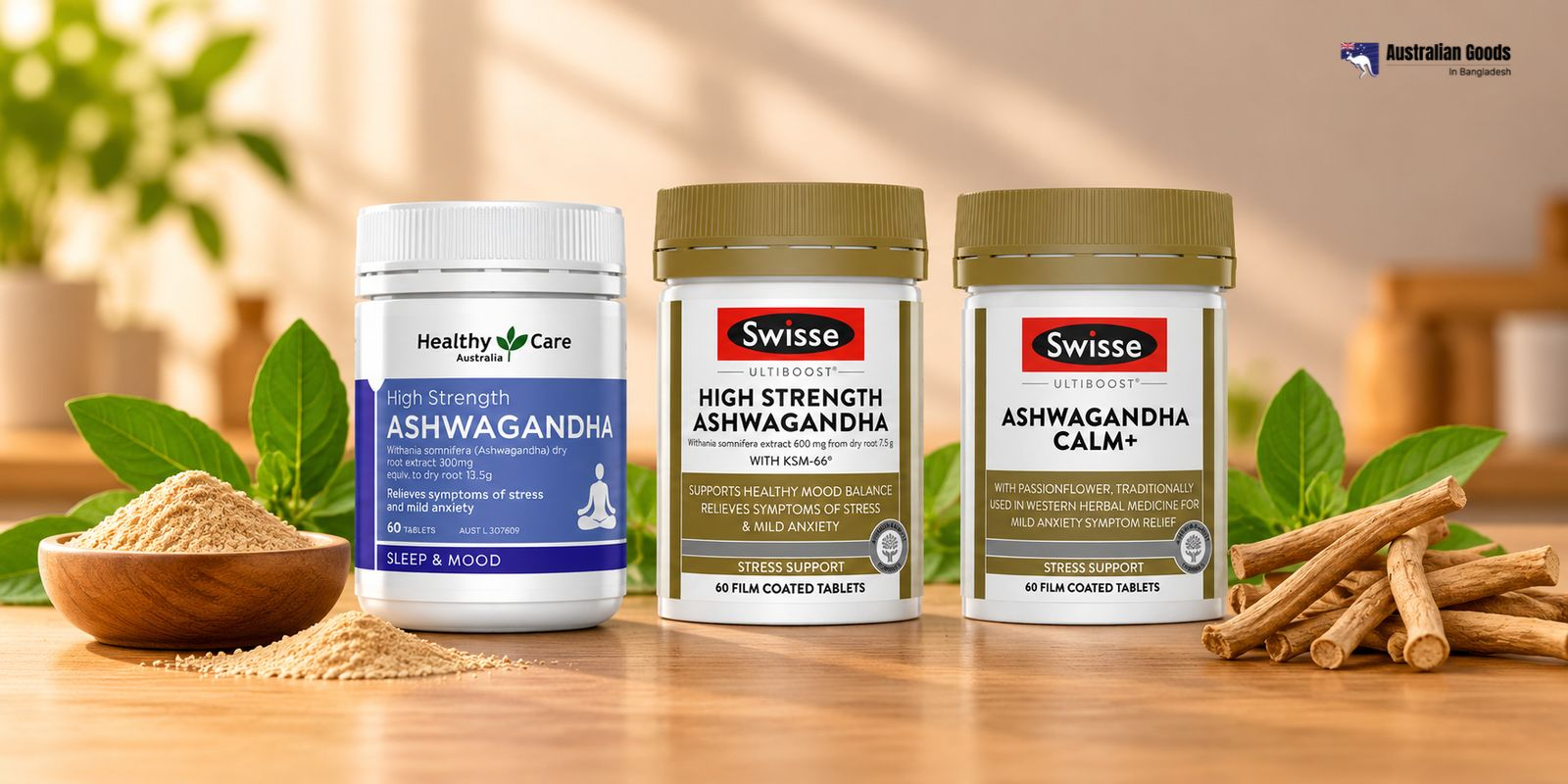
Before buying ashwagandha in Bangladesh, check two things: whether it is suitable for you and what the label actually contains. A bottle advertised for stress, sleep or “high strength” may have a different extract and daily serving from another bottle.
This guide covers the evidence and safety checks first, then shows how to compare labels. Product examples are for understanding the differences; they are not a recommendation to take several supplements together.
What is ashwagandha?
Ashwagandha (অশ্বগন্ধা), or Withania somnifera, is a plant used in Ayurvedic medicine. Supplements may contain root powder, root extract or root-and-leaf extract. These preparations are not interchangeable.
Withanolides are naturally occurring compounds used as markers in some standardised extracts. A stated amount helps describe a formula, but it does not by itself prove that a product will work better. NCCIH explains the different preparations and evidence limits.
What benefits does research support?
Some preparations show promise for stress and sleep. Many studies are small, short and use different extracts, so a result for one preparation should not be applied to every product.
| Reason for use | What the evidence means |
|---|---|
| Stress | Some preparations may improve stress-related symptoms. Benefits are not guaranteed, and a supplement does not replace support for persistent distress. |
| Sleep | Some studies report improvements in sleep or insomnia symptoms. Ongoing insomnia, snoring with breathing pauses or daytime sleepiness needs assessment. |
| Anxiety | NCCIH describes the evidence as unclear. Ashwagandha should not be presented as a treatment for an anxiety disorder. |
| Testosterone or fertility | Limited studies suggest changes in testosterone or sperm quality in some settings. This does not establish a general testosterone booster or an infertility treatment. |
These distinctions follow NCCIH guidance and the NIH Office of Dietary Supplements evidence review. Claims that ashwagandha cures anxiety, depression or insomnia, works immediately, or is safe for everyone go beyond this evidence.
What are the side effects and liver warnings?
Possible side effects include drowsiness, an upset stomach, diarrhoea and vomiting. “Natural” does not mean risk-free.
The TGA safety alert, updated 7 July 2026, warns that very rare liver injury can be serious. Avoid ashwagandha if you currently have, or previously had, liver problems.
- Stop taking it and seek medical advice for yellow skin or eyes, dark urine, nausea, vomiting, unusual tiredness, weakness, abdominal pain or loss of appetite.
- Sudden vomiting or diarrhoea can occur even after one or two doses. Stop and see a doctor; this reaction does not necessarily mean liver injury.
Who should avoid it or check with a professional first?
NCCIH safety guidance identifies groups for whom ashwagandha may be unsuitable:
- Pregnancy and breastfeeding: avoid use. If planning pregnancy, ask for advice before starting.
- Thyroid or autoimmune disorders, upcoming surgery: ashwagandha is not recommended without appropriate clinical guidance.
- Hormone-sensitive prostate cancer: avoid ashwagandha.
- Regular medicines: check for interactions, particularly with thyroid hormones, sedatives, anticonvulsants, immunosuppressants and medicines for blood pressure or diabetes.
Show your healthcare professional the full ingredient list and everything else you take. Do not stop prescribed medicine to try a supplement. Adult product directions should not be used to work out a child's dose.
What dose and timing should you follow?
Use the supplied product directions; there is no universal dose or best time for every ashwagandha formula. Check the number of tablets, whether to take them with food and any warnings. Do not assume a stress-support product must be taken at bedtime.
The NIH review describes studies lasting several weeks, often six to eight weeks for stress. That is a research timeframe, not a promise about when you will feel a benefit.
Some preparations may be tolerated for up to about three months, but long-term safety is uncertain. Discuss continued use, especially if symptoms persist. Do not combine a high-strength tablet with a calming blend or night formula without having the total ingredients reviewed.
How do you read an ashwagandha label?
Compare the same measurements before deciding that one product is stronger.
| Label detail | What to check |
|---|---|
| Plant part and preparation | Root powder, root extract and root-and-leaf extract describe different preparations. |
| Extract amount | The milligrams of extract in each tablet or serving. |
| Equivalent dry plant | The amount of plant material represented by the extract. It is not an extra quantity of extract. |
| Standardisation | Any declared withanolide amount or percentage. Do not assume a percentage that the label does not state. |
| Daily serving | One tablet and two tablets can supply different daily amounts, even when front-label numbers look similar. |
| Other ingredients | Additional herbs, nutrients, allergens and warnings that could change suitability. |
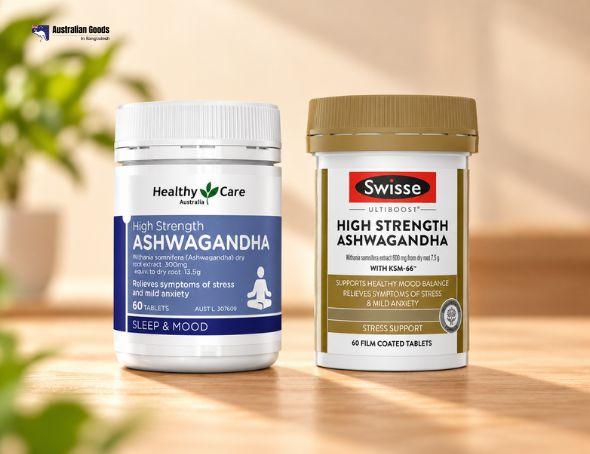
A single-herb example: Healthy Care lists 300 mg of dry-root extract per tablet, equivalent to 13.5 g of dry root. Its adult directions are two tablets daily or as professionally directed. That supplies 600 mg of extract daily; a 60-tablet bottle provides 30 labelled servings. The 13,500 mg plant-equivalent figure is not 13,500 mg of extract. Check the manufacturer label.

Healthy Care High Strength Ashwagandha
Healthy Care High Strength Ashwagandha is an Australian-made herbal supplement for adults, formulated to help relieve symptoms of stress and mild anxiety and support the body’s abi...
Should you choose a single herb or a blend?
A single-herb formula makes the ashwagandha amount easier to identify. A blend adds other active ingredients, so compare the whole formula and check for overlap with supplements you already use. Neither format is automatically better.
A blend example: Swisse Ultiboost Ashwagandha Calm+ combines ashwagandha with magnesium, passionflower and reishi. Its adult directions are two tablets daily, during or immediately after a meal. It should not be compared with a single-herb product by ashwagandha milligrams alone. See the complete Swisse formula and warnings.

Swisse Ultiboost Ashwagandha Calm+
Swisse Ultiboost Ashwagandha Calm+. Compare ingredients, labelled serving, pack value and current Bangladesh price. Read suitability and medicine warnings.
For the differences between Healthy Care, Swisse High Strength and Calm+, including daily servings and cost comparisons, use the dedicated comparison below.
What should you check when buying in Bangladesh?
- Check suitability first. Review the safety guidance above before choosing a brand or price.
- Match the exact pack. Confirm the formula, tablet count and directions on the supplied bottle rather than relying on an old product photo.
- Check seller traceability. Look for a clear business contact, purchase record, intact seal, readable batch number and expiry date. Packaging appearance alone cannot prove authenticity.
- Compare cost per labelled day. Divide the pack price by its number of daily servings. A cheaper bottle may contain fewer days of use; value still depends on suitability.
- Follow the storage label. The Healthy Care example specifies below 30°C; Calm+ specifies below 25°C, in a dry place. Keep packs away from heat, direct sunlight and moisture. A hot vehicle or humid bathroom may not meet those directions.
Once you have checked suitability and the label, browse ashwagandha products in Bangladesh for current pack details and prices. The product page and supplied label should agree before use.