Maca vs Oyster vs Horny Goat Weed: Differences, Uses & Safety
Maca, oyster extract and horny goat weed belong to different ingredient groups. This comparison explains their evidence, common label misunderstandings, safety considerations and real product examples, helping you compare men’s-health supplements in Bangladesh without confusing a larger number with a better choice.
Quick Answer
Maca is a plant ingredient, oyster extract comes from shellfish, and horny goat weed refers to Epimedium herbs. Maca has small human studies on desire, oyster products require a separate zinc check, and horny goat weed has limited clinical evidence. Compare the exact formula and warnings; none is an established replacement for prescribed erectile-dysfunction treatment.
Key Takeaways
- Maca, oyster extract and horny goat weed are different ingredients, not different strengths of one supplement.
- Oyster-extract milligrams do not reveal elemental zinc content; use the actual zinc declaration when one is provided.
- An extract amount and a plant-equivalent amount describe different quantities and should not be added together.
- A combination product still needs allergy, medicine and health-condition checks.
- Compare the exact market-specific formula and cost per labelled daily serving before purchasing.
Turn over three men’s-health bottles and the comparison quickly becomes more interesting than the front labels. One lists a Peruvian plant. Another adds a shellfish extract. A third includes several herbs with large “equivalent” amounts.
Maca, oyster extract and horny goat weed are different ingredients, not three strengths of the same supplement. Understanding that difference helps you compare products in Bangladesh without mistaking a plant-equivalent number, a mineral claim or a traditional use for proof of better results.
Maca vs oyster vs horny goat weed: the main difference
Maca is a botanical; oyster extract is derived from shellfish; horny goat weed is an Epimedium herb. Maca has some small human studies on sexual desire, oyster products require careful nutrient and allergy checks, and horny goat weed relies heavily on traditional use and preliminary research. None is an established substitute for prescribed erectile-dysfunction treatment.
| Ingredient | What it is | Useful label check | Main limitation |
|---|---|---|---|
| Maca | Lepidium meyenii, a plant used as food and in supplements | Powder or extract, actual amount and dry-tuber equivalent | Findings from a study preparation do not apply automatically to every product |
| Oyster extract | A shellfish-derived ingredient | Declared elemental zinc, other ingredients and allergens | Oyster-extract weight is not the zinc dose |
| Horny goat weed | Herbs from the Epimedium genus | Species, plant part, extract amount and warnings | Traditional use does not establish reliable clinical benefit |
The useful question is therefore “What does this formula contain, and does it fit my needs?” rather than “Which ingredient sounds strongest?”
Maca: desire is not the same as testosterone
Maca labels may describe powder, gelatinised maca or an extract. These preparations should not be assumed to be equivalent. Check the complete ingredient list separately for dietary suitability.
There is some human research, but it is smaller and more specific than broad marketing claims suggest. A randomised trial in healthy adult men reported improved sexual desire during a 12-week study of gelatinised maca without the effect being explained by testosterone changes. That does not make maca a hormone treatment or show that a different extract will produce the same result.
For a buyer, the practical distinction is between a straightforward maca formula and a blend that happens to contain maca. If you want to compare maca itself, check the preparation and daily serving before comparing price.
Oyster extract: read the zinc line separately
Oysters are a food source of zinc, but an oyster supplement is not automatically a standard-dose zinc supplement. A statement such as “oyster extract 500 mg” tells you the weight of that ingredient. It does not mean 500 mg of zinc, and it does not establish any particular zinc dose.
Look for a separate declaration such as “equivalent zinc” or “elemental zinc.” If none is supplied, ask for the current label rather than estimating. The NIH zinc fact sheet explains the distinction between elemental zinc and compound weight.
Zinc is essential, but extra zinc is not a guaranteed testosterone booster. Repeated high intake can cause harm, including copper deficiency. Count zinc already present in a multivitamin or another supplement. Oyster also matters for shellfish allergy and dietary preferences; a natural origin does not remove those considerations.
Horny goat weed: what does the research show?
Horny goat weed usually refers to Epimedium species. You may also see the compound name icariin in discussions of the herb. Laboratory findings about a compound are not the same as evidence that an over-the-counter tablet treats a sexual-health condition.
Memorial Sloan Kettering describes limited clinical evidence and a need for better safety and effectiveness studies. Its guidance advises avoiding the herb in people with heart disease or hormone-sensitive cancers. Reported adverse effects include an irregular heartbeat and mood changes.
Read the warnings before choosing a blend that includes it, especially if you take medicines. A bold ingredient name on the front does not tell you whether the complete formula is suitable for you.
How the three product examples differ
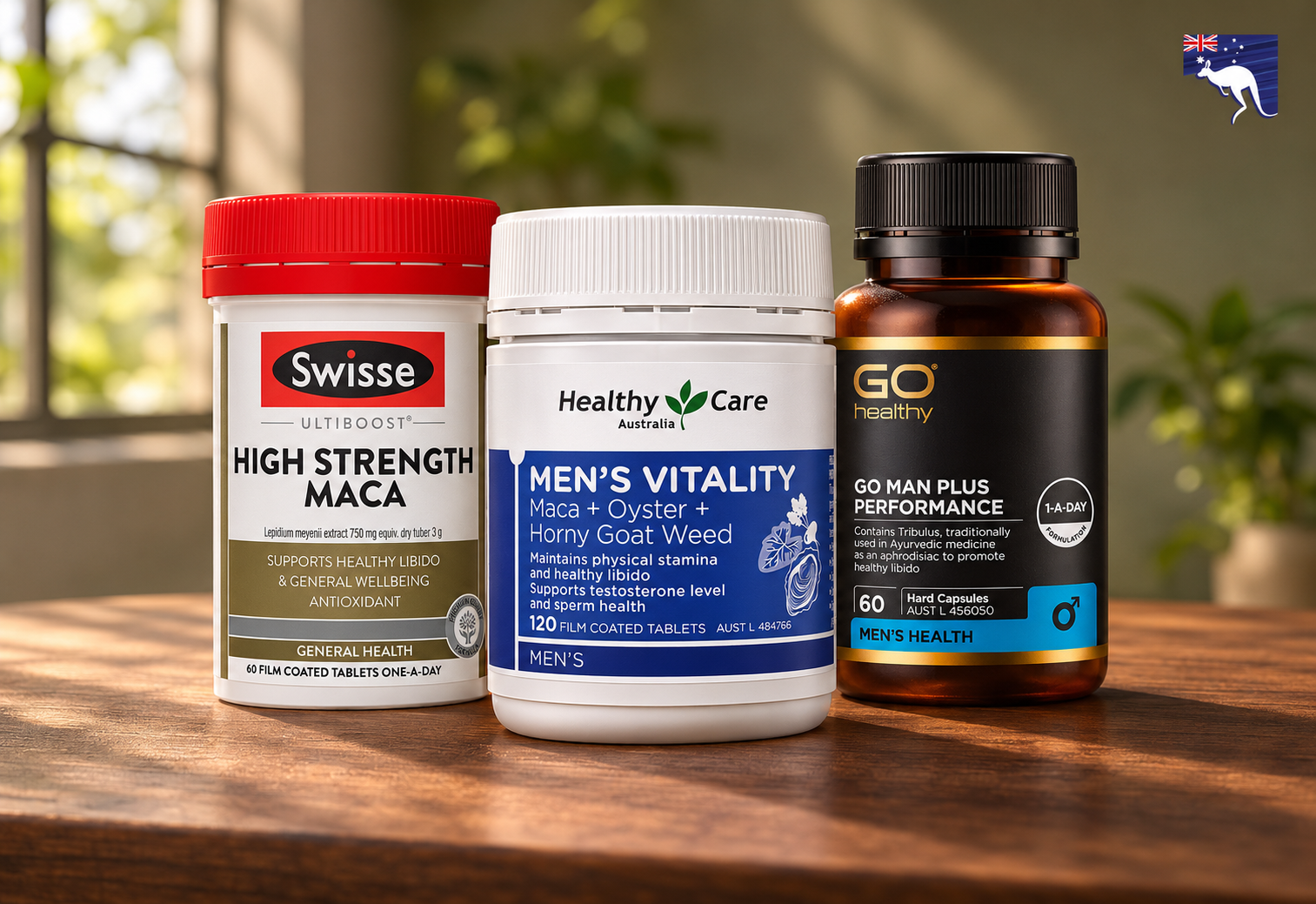
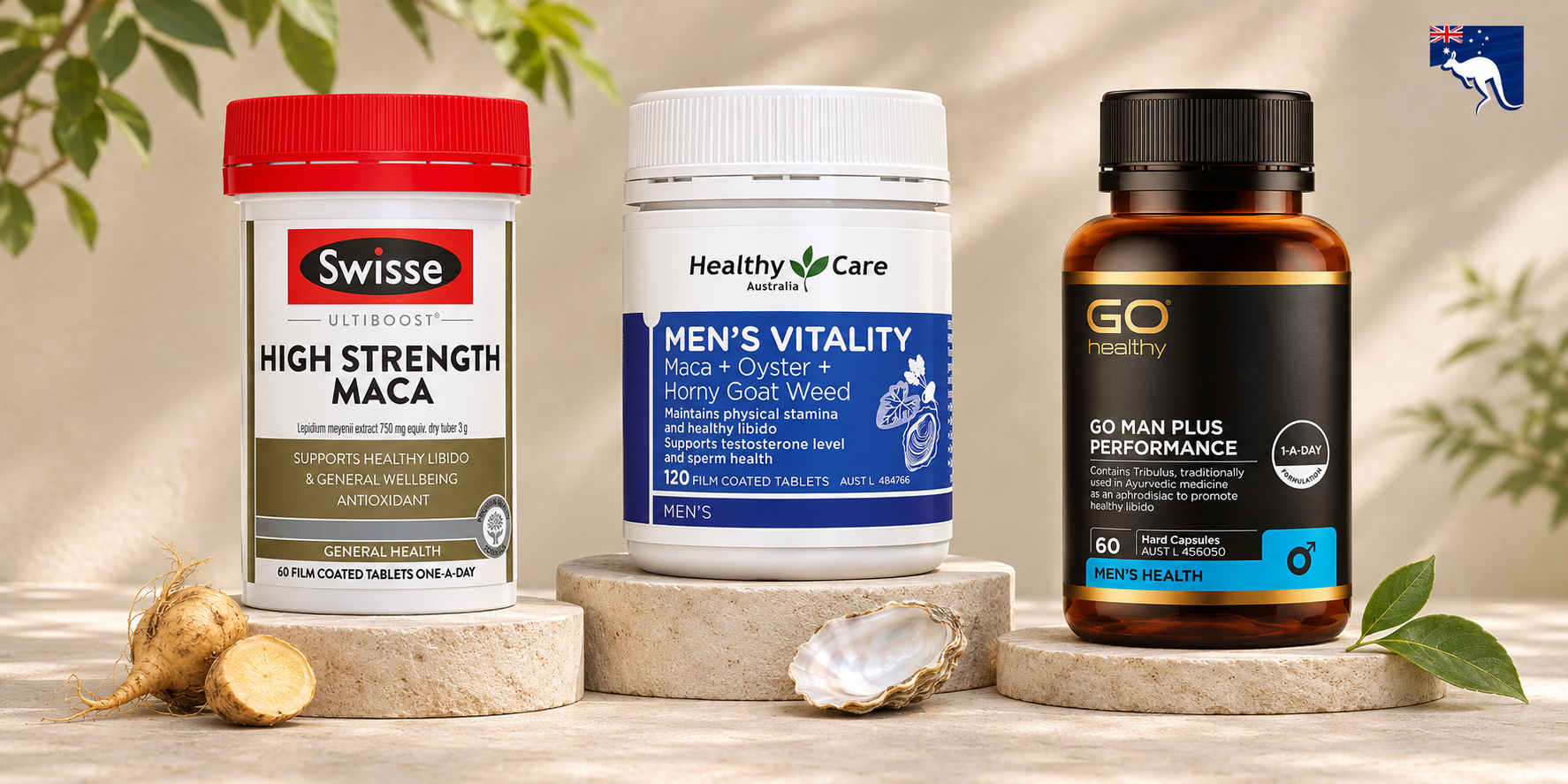
Swisse High Strength Maca: a single-herb example
The Swisse ingredient panel declares maca extract equivalent to 3 g of dry tuber per tablet. Its labelled adult serving is one tablet daily, with or immediately after a meal. This is useful when comparing a simpler formula with products containing several active ingredients.
The dry-tuber equivalent describes source material. Do not read it as 3 g of extract, and do not assume it matches 3 g of powder used in a clinical study.
Healthy Care Men’s Vitality: maca with oyster and horny goat weed
Healthy Care identifies these three ingredients in its Men’s Vitality formula. The combined approach makes checking the whole panel particularly important. Confirm the supplied pack’s amounts and serving instead of treating the three front-label names as three separately measured supplements.
For someone comparing dietary restrictions, oyster is the clearest difference from a maca-only product. For someone comparing zinc intake, the decisive detail remains the actual zinc declaration, if provided.
GO Man Plus Performance: a broader herbal blend
The Performance product listed by Australian Goods combines tribulus, horny goat weed, ginkgo, Korean ginseng and grape seed. The name needs to match: overseas GO MAN PLUS listings may describe other ingredients. If Korean, red and American ginseng labels are causing confusion, our ginseng types and buying guide explains the distinctions.
You can examine the current packs and prices in the related products below. Use the labels to compare the formulas rather than assuming that the same broad men’s-health category makes them interchangeable.
Healthy Care Men's Vitality Maca + Oyster + Horny Goat Weed is an Australian made men's health supplement formulated to support energy, stamina and healthy libido. It combines Maca...
Healthy Care Men's Vitality Maca + Oyster + Horny Goat Weed 120 Tablets
A simple way to compare the numbers
When two labels look confusing, put these four details beside one another:
- Preparation: powder, extract or a blend of ingredients.
- Amount per unit: what one tablet or capsule actually supplies.
- Daily serving: how many units the supplied label directs.
- Source equivalent: whether a larger number refers to dry tuber, leaf, root or fresh plant material.
For example, an extract weight of 300 mg and a stated dry-leaf equivalent of 6 g describe two aspects of one ingredient. They are not separate quantities to add together. Nor can the 6 g number fairly be compared with 3 g of a different plant to declare one product “twice as strong.”
Price comparisons need the same care. Divide pack count by the labelled daily serving to find days per pack, then divide the current taka price by that number. A cheaper bottle can cost more per day if its serving uses more tablets. This calculation measures cost, not expected benefit.
Before combining products
If you take regular medicine, show the complete label to a pharmacist before starting. Ginkgo in a blend can interact with blood-thinning medicines, and Asian ginseng can affect blood sugar and sleep. These concerns are explained in NCCIH’s ginkgo and Asian ginseng guidance.
Do not build a combination by adding separate maca, oyster and horny goat weed products to an existing men’s formula. You may duplicate ingredients without knowing whether the total is suitable. Our men’s vitality buying guide helps connect those label details with the reason you are shopping.